August 31, 2026|י"ח אלול ה' אלפים תשפ"ו As Jewish as a Ham Sandwich: Ben Shapiro, Chabad, and What It Means to Be Jewish
Print Article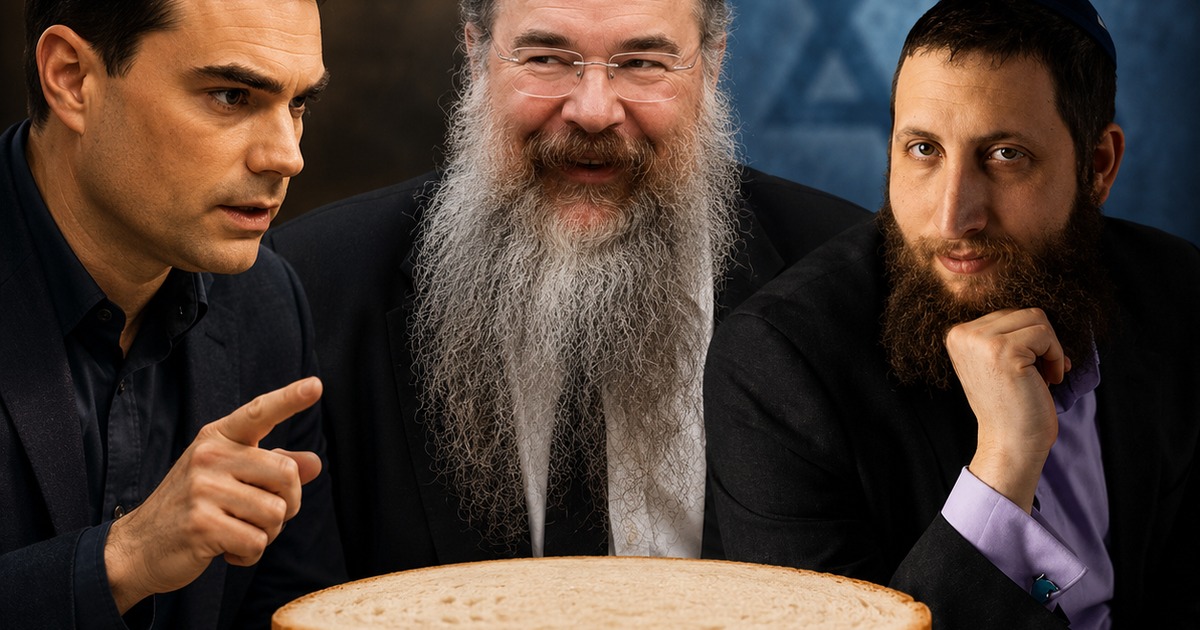
A fascinating debate broke out online last week over a question that sounds semantic but is actually profound. Though it wasn’t framed this way, to me, the question being debated was essentially: is there a difference between being a Jew and being Jewish?
It began when comedian Hannah Einbinder expressed views sharply critical of Israel (not for the first time). Ben Shapiro responded, “Hannah Einbinder is about as Jewish as a ham sandwich.” He added, “If you believe that these people represent Jews or Judaism, then you believe Madonna represents Catholics or Catholicism.”
When someone, whether a celebrity or grassroots activist, invokes the “as a Jew” card to lend credibility to an argument or position that he regards as anti-Jewish, Ben’s response on several occasions has essentially been: Don’t use your Jewish identity to validate an argument that is antithetical to Judaism or harmful to the Jewish people.
Rabbi Mordechai Lightstone of Chabad.org pushed back. “There are many ways to criticize bad arguments,” he wrote. “Saying people who are indeed Jewish are about as Jewish as a ham sandwich is simply not it.” Shapiro responded: “Wrong. Using the mantle of Jewishness, something Einbinder and company demonstrate zero actual commitment to, in order to promote anti-Judaic insanity is fundamentally un-Jewish and ought to be called out as such.”
Then Rabbi Shais Taub joined the fray. “Torah is the final arbiter of all matters, including Jewish status,” he wrote. “You cannot revoke someone’s Jewishness even if you believe they are using that very status to advance ideas that are to the detriment of the Jewish people.” Rather than push such Jews away, he argued, we should devote ourselves to bringing our brothers and sisters back into the fold.
So who is right? When a Jew invokes “as a Jew” while advancing ideas we believe are deeply damaging to Judaism, Israel, or the Jewish people, do we say, “You’re about as Jewish as a ham sandwich”? Or is a Jew a Jew now and forever, and our responsibility is always to love them, embrace them, and try to bring them closer? The answer may be both.
The Gemara in Sanhedrin famously describes the sin of Achan, who disobeyed Hashem’s command not to take from the spoils of Yericho, with the words, ישראל אף על פי שחטא ישראל הוא, even though a Jew has sinned, he remains a Jew. The Gemara offers a beautiful metaphor: A myrtle standing among thorns remains a myrtle and is still called a myrtle. Achan’s crime was devastating and damaging: he had not merely committed some private aveirah, rather his actions brought catastrophe upon the Jewish people. Nevertheless, Chazal insist that his essential identity remained unchanged.
The Gemara in Yevamos takes this even further. A convert who properly completes the conversion process is k’Yisrael l’chol devarav, Jewish in every respect. What happens if that convert later abandons Judaism? He remains a Jew. If he marries and decides to abandon Yiddishkeit, his kiddushin remains valid because he is now a Yisrael mumar, an apostate Jew, but a Jew nonetheless. The Rambam codifies the same principle regarding someone born Jewish who converts to another religion. Even if he willingly worships idols, his kiddushin remain fully binding. There is no reverse conversion. There are no backsies. Once you are a Jew, you are a Jew forever.
The Gemara in Kiddushin adds another dimension. The Torah says, בנים אתם לה׳ אלקיכם, “You are children of Hashem your God.” Rabbi Yehuda understands this conditionally: Only when we behave like Hashem’s children are we called His children. When we do not, we lose that designation. Rabbi Meir disagrees: בין כך ובין כך אתם קרויים בנים, either way, you are called children. The Gemara supports Rabbi Meir with a series of pesukim describing Jews as foolish children, faithless children, even destructive children. The Torah is telling us something: at times we may act like terrible children, but we remain children.
Remarkably, the Rashba writes that although we ordinarily follow Rabbi Yehuda in a dispute between Rabbi Yehuda and Rabbi Meir, here the halacha follows Rabbi Meir because the pesukim brought by the Gemara support him. As any parent can relate to, no matter what we do to upset our Father in Heaven, we remain Hashem’s children.
That is particularly important as we enter Elul and approach Rosh Hashanah and Yom Kippur. Some of us look back at the year and feel inadequate. We have made the same mistakes again. We have disappointed ourselves and Hashem. Maybe we wonder whether we have exhausted His patience. But still we pasken like Rabbi Meir. Banim atem laHashem Elokeichem. You are still His child and will always be his child.
Rebbe Mordechai of Kuzmir finds a beautiful allusion in the unusual formulation banim atem. Why does the Torah need the word atem? Elsewhere, regarding the rabbinic authority over the Jewish calendar, Chazal derive from the word osam: אתם אפילו שוגגין, אתם אפילו מזידין, אתם אפילו מוטעין—even when you err unintentionally, even deliberately, even when you are mistaken. Rebbe Mordechai takes the same word with different vowelization – “Atem” – and reads the same message here: Banim atem. You remain Hashem’s children afilu shogegin, afilu mezidin, afilu mut’in. When we make mistakes, when we knowingly make the wrong choices, even when we are confused and lost, Hashem has not given up on us.
This is why the Gemara says that a communal fast that does not include the sinners of Israel is not a proper fast. It is why, before Kol Nidrei, we announce, אנו מתירין להתפלל עם העבריינים, we permit ourselves to pray together with the transgressors. And who are the transgressors? We might imagine we are welcoming the Jew who drove to shul on Yom Kippur. But if we are honest, we are also talking about ourselves. We are all the avaryanim. None of us should imagine that we are so perfect that we automatically deserve a place in the room.
This is a running theme throughout much of Jewish law and thought. The chelbenah, the malodorous spice, was nevertheless essential to the ketores. The aravah has neither taste nor fragrance, yet without it there are no complete arba minim. Klal Yisrael includes Jews who are distant, confused, alienated, and sinful. The very word we use to describe a community, “צבור - Tzibbur,” many point out, stands for “Tzaddikim, Beinonim, V’R’shaim.”
These sources certainly sound like they support the approach of Rabbis Lightstone and Taub. A Jew is a Jew, always a child of Hashem.
So was Ben Shapiro simply wrong, is his approach extreme, unforgiving and maybe even inaccurate? Not necessarily. The Rishonim introduce another category that changes the conversation. There is Yisrael, and there is “Achicha.” Yisrael describes who you fundamentally are. Achicha, your brother, describes how you participate in the covenantal fraternity of the Jewish people and how we relate to you.
The Maharam Mi’Rutenburg distinguishes between the two. Certain Halachos are based simply on being Jewish. Gittin and kiddushin, marriage and divorce, for example, remain fully operative even for an apostate Jew. But other mitzvos are explicitly formulated in terms of achicha. The Torah commands us to return aveidas achicha, our brother’s lost object. We may not charge our brother interest. Somebody can therefore remain Yisrael while forfeiting aspects of achva. There are times we are instructed, even obligated, to treat a Jew as if he was not a Jew.
There are, in other words, two levels: דרגת ישראל ודרגת אחוה. When it comes to Jewish identity, Hashem decides who is a Jew. And a Jew is a Jew is a Jew. But achva describes the way we relate to and behave toward our fellow Jews. If someone deliberately removes himself from the Jewish people and works against them, the Rishonim recognize that those choices can affect that status and that status affects the privileges he or she enjoys and how we relate to him or her.
This is where the conversation becomes especially relevant today. The Rambam describes the poresh midarkei tzibbur, one who separates himself from the Jewish community, in startling language: אף על פי שלא עבר עבירות, even though he has committed no aveiros. Imagine someone who keeps Shabbos, is meticulous about kashrus and is personally scrupulous about halacha. But he is nivdal mei’adas Yisrael, he separates himself from the Jewish people. Continues the Rambam,ולא נכנס בצרתן, he does not enter into their suffering. He does not feel their pain. Their enemies are not his enemies. Their danger is not his danger. Their destiny is not his destiny. He conducts himself, says the Rambam, k’ilu eino meihem, as though he is not one of them. That is itself a profound religious failure and it impacts his place in the community in this world and his very entrance to the next one.
We need to be exceedingly careful here. Criticizing Israel or its government, leaders, or officers does not make someone an enemy of the Jewish people. Advocating for Palestinians does not remove someone from achva. There is plenty about Israel and about the Jewish community that can legitimately be criticized. Where exactly the line is crossed is a serious and complicated halachic question, and labels such as mumar, moser, and poresh midarkei tzibbur (and more modern terminology like “Kapo” or “self-hating Jew”) should not be thrown around casually. But there is a difference between criticizing policies and leveling blood libels against the Jewish state. There is a difference between advocating for another people and actively undermining the safety and security of your own, a clear distinction between disagreement and disassociation.
Moshe Rabbeinu provides the opposite model: ויגדל משה ויצא אל אחיו וירא בסבלותם, Moshe went out to his brothers and saw their suffering. What helped make Moshe the quintessential leader of the Jewish people was precisely achva. He saw other Jews as his brothers. Rashi tells us that he placed his eyes and heart upon their suffering. Jewishness is not only what you eat, how you observe Shabbos, or which mitzvos you perform. It is also whose pain you feel, whose fate you share, and whom you call your brother.
And that brings us back to Ben Shapiro’s ham sandwich. Perhaps what the conversation is missing is distinguishing between the noun Jew and the adjective Jewish. Jew is an identity. Jewish is a description. A Jew you are forever. Yisrael af al pi shechata, Yisrael hu. Even if you espouse ideas as non-kosher as a ham sandwich, you remain a Jew. Only Hashem determines Jewish identity, and no tweet, political position, or personal rebellion can undo it.
But are your ideas Jewish? Are your actions Jewish? Are you behaving Jewishly? Are you a representative of the Jewish people? Are you living with achva, seeing other Jews as achicha? That is a different question. In that sense, Ben’s formulation can be understood differently, and to me is compelling. He was not, to me, saying that such a person is no longer a Jew. He was saying that invoking “as a Jew” does not magically make an argument Jewish. You can be a Jew while espousing profoundly un-Jewish ideas.
Indeed, when espousing un-Jewish and anti-Jewish ideas with the introduction “as a Jew,” it is particularly dangerous and damaging. Historically, apostate Jews often walked away and disavowed their Jewish identity. They sought to assimilate, integrate, and erase their status as Jews. Today, by contrast, some of the most vociferous voices leveling false accusations against Israel have abandoned the Rambam’s basic criteria for being worthy of achva status, all while prominently waving the “as a Jew” card.
In that sense, perhaps the ham sandwich metaphor is particularly fitting. Chazal describe the pig as stretching out its split hooves, as if to announce, “Look, I am kosher,” while concealing the fact that it does not chew its cud and is therefore not kosher at all. The pig is a symbol not merely of what is forbidden, but of the hypocrisy of publicly displaying the credential that suggests legitimacy while behaving in a way that contradicts it. There is something similarly troubling about invoking one’s Jewish identity not as a source of responsibility to the Jewish people, but as a credential to lend greater legitimacy to those who attack them. The repeated declaration “as a Jew” can become the outstretched hoof, holding up Jewish identity precisely while advancing ideas profoundly at odds with Jewish solidarity and responsibility.
Rav Soloveitchik’s famous distinction between Bris Avos and Bris Sinai helps illuminate this further. Before Sinai, we already had a covenant. We were the descendants of Avraham, Yitzchak and Yaakov. Bris Avos makes us a family. It gives us a common history, identity, belonging, loyalty, and destiny. Then came Bris Sinai. At Sinai we said na’aseh v’nishma. We accepted Torah, Halacha, and mitzvos.
This distinction is embedded in Birchas HaTorah: אשר בחר בנו מכל העמים ונתן לנו את תורתו. First, bachar banu—He chose us, a people. Then, v’nasan lanu es Toraso—He gave us the Torah. Peoplehood precedes obligation. Bris Avos precedes Bris Sinai.
Tragically, much of the Jewish world today shares our Bris Avos but not our Bris Sinai. They may not observe Shabbos or kashrus, may not believe in Torah min HaShamayim, and may know little about mitzvos. But they identify passionately with the Jewish people. Israel matters to them. Jewish suffering hurts them. Jewish celebrations move them. We may desperately want to help them discover Bris Sinai, but we already share Bris Avos.
There are also Jews with whom we share Bris Sinai but who seem strangely disconnected from Bris Avos, from the larger Jewish family and its collective fate. And then there is the most painful possibility: someone who seems to reject both. Neither Bris Sinai nor Bris Avos. Neither the covenant of Torah nor identification with the fate and family of the Jewish people. Perhaps that is the person the Rambam describes as k’ilu eino meihem—someone who behaves as though he is not one of us.
So who is right, Ben Shapiro or Rabbis Lightstone and Taub? Rabbis Lightstone and Taub are unquestionably right about the Jew. Yisrael af al pi shechata, Yisrael hu. A Jew is a Jew. We don't give up on another Jew because Hashem doesn't give up on another Jew. Banim atem laHashem Elokeichem. We should reach out, invite, educate, inspire, put on tefillin together, share a Shabbos table, and try to awaken the Jewish soul that remains present no matter how deeply buried.
But Ben is right about the word Jewish. Being born a Jew does not make everything one says a Jewish position. Invoking “as a Jew” does not give Torah credibility to an idea. Jewish identity is unconditional but living Jewishly is not. A Jew is never a treif piece of ham but an idea, even if said by a Jew, can be and sometimes it is necessary to point that out, protest and set the record straight.
You can never stop being a Jew. But you can certainly stop acting very Jewish. And perhaps the challenge is not merely to decide which description applies to someone else.
Elul asks each of us the same question. Hashem has already decided that we are His children. Nothing can change that. The question we have to answer is: How Jewishly are we choosing to live?