October 20, 2026|ט' חשון ה' אלפים תשפ"ז Do You Know, Let Alone Celebrate, Your Hebrew Birthday?
Print Article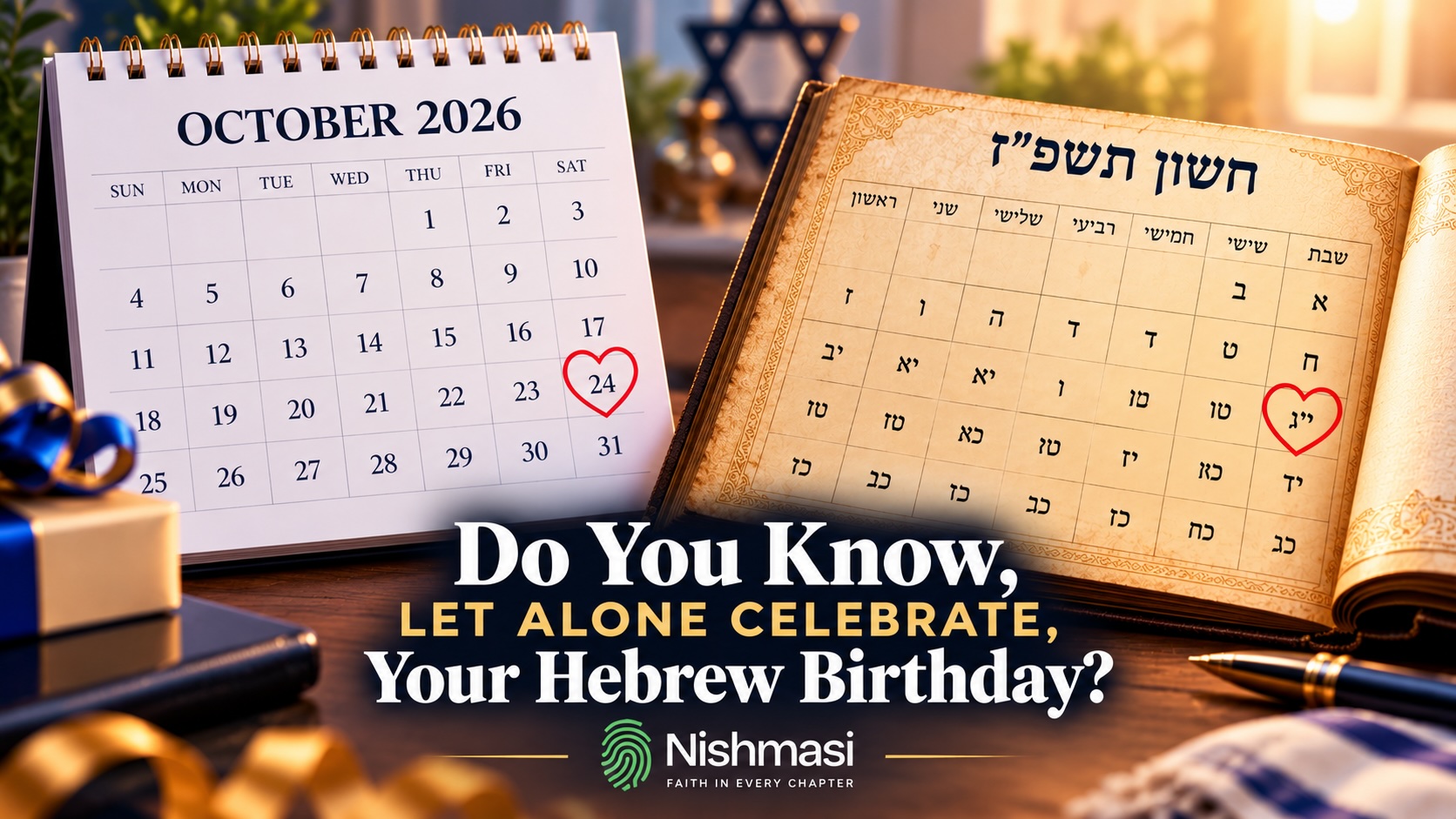
Our phones know our birthdays, social media reminds our friends, Google Calendar sends notifications, and restaurants and retailers celebrate by sending us coupons and special offers. We receive countless birthday wishes, messages, and emojis, sometimes from people we haven't spoken to in years. We have never had more ways to remember our birthdays, yet perhaps we have never spent less time thinking about what they actually mean.
Of all the billions of people who have ever lived, there has never been and never will be another you. Your personality, talents, challenges, relationships, and circumstances make you absolutely unique. You have your own fingerprint, your own neshama, and your own mission.
The Gemara in Megillah (13b) describes how Haman cast lots to determine the most auspicious time to destroy the Jewish people. When the lot fell in Adar, he was delighted, knowing that Moshe Rabbeinu had died in that month. What he failed to appreciate, says the Gemara, is that Moshe was also born in Adar, on the very same date, the seventh of the month. Haman focused on an ending but overlooked the extraordinary significance of a beginning.
The Yerushalmi (Rosh Hashanah 3:8) teaches that on one's birthday, mazalo goveir, one's mazal is strengthened. While the precise spiritual significance of mazal is beyond our understanding, clearly the anniversary of our arrival in this world is more than a historical detail. In 1988, the Lubavitcher Rebbe launched a campaign encouraging Jews to celebrate their Hebrew birthdays through increased Torah learning, tefillah, tzedakah, reflection, and spiritual growth. A birthday is not simply the anniversary of our arrival, but the anniversary of Hashem entrusting us with a mission.
The Mishnah in Sanhedrin (4:5) teaches that Hashem created Adam as a single individual to impress upon us the infinite value of every life. Bishvili nivra ha'olam, the world was created for me. This is not an invitation to arrogance, but a call to responsibility. If the world was created for me, what am I doing with the extraordinary opportunity of my existence?
There is someone you are meant to influence, something you are meant to accomplish, and goodness you are meant to bring into the world that nobody else can deliver in precisely the way you can.
And yet we spend so much time comparing ourselves with others, measuring our careers, families, homes, accomplishments, and even spiritual growth against carefully curated versions of other people's lives. But Hashem didn't create us to be somebody else. Our job is not to live someone else's life better than they do, but to live our own lives as faithfully and purposefully as we can.
This is part of the message of our new project Nishmasi (Nishmasi.org), my soul, my unique relationship with Hashem and my irreplaceable mission. Our fingerprint represents our individuality, but it also unlocks things and leaves an impression. Our birthday should inspire us to consider whether we are unlocking our potential, becoming the best version of ourselves, and leaving the fingerprint on this world that only we can leave.
But Which Birthday Should We Celebrate?
Do you know your Hebrew birthday? Not the Gregorian date on your driver's license or passport, but the Jewish date on which you entered this world? And if you know it, do you celebrate it?
Consider that Jews of virtually every background and level of observance commemorate the yahrzeit of a loved one according to the Hebrew calendar. We light a candle, say Kaddish, learn Torah, and give tzedakah on the Jewish anniversary of someone's passing. Yet when it comes to birthdays and wedding anniversaries, even many knowledgeable and observant Jews don't know, let alone celebrate, their Hebrew dates.
Why are we so careful to remember the Jewish date on which someone left this world, but often neglect to celebrate the Jewish date on which they entered it?
There is nothing wrong with acknowledging a secular birthday, enjoying the cake, presents, and good wishes. But if that is the only birthday we celebrate, we are missing an extraordinary opportunity to reconnect with who we are, why we are here, and what Hashem expects of us.
Jewish time is not merely linear, with the past behind us and the future ahead. It is cyclical, or perhaps more accurately, a spiral. We return to the same points on the calendar each year, but we are not the same people. Rosh Hashana offers new beginnings, Pesach the possibility of liberation, and Chanukah the power of light to overcome darkness. We aren't simply commemorating historical events, but revisiting moments charged with spiritual opportunity, bayamim ha'heim u'vizman hazeh.
What is true of our national calendar is equally true of our personal one. A wedding anniversary invites us to revisit our commitment, a yahrzeit challenges us to perpetuate a loved one's legacy, and our Hebrew birthday reminds us that Hashem brought us into this world for a reason and continues to give us the opportunity to fulfill it.
Reclaiming Jewish Time and Jewish Identity
When we think about assimilation, we tend to picture someone abandoning Jewish observance or distancing themselves from Jewish life. But assimilation can be far more subtle. Sometimes it isn't about what we abandon, but about allowing the surrounding culture to define our consciousness, priorities, and even our understanding of time.
The Chasam Sofer strongly opposed using secular dates, and while normative halachic practice permits their use, Rav Ovadia Yosef emphasizes the virtue of dating documents according to the Jewish calendar and, when appropriate, including the Hebrew date alongside the secular one. The issue is not whether we are permitted to write October 2026, but which calendar shapes our identity.
We have never had more sophisticated tools to organize our lives. Our calendars sync across devices, our watches remind us of appointments, and artificial intelligence can help us manage schedules and commitments. Yet we risk becoming extraordinarily efficient at managing our days while losing sight of what makes those days meaningful. Our calendars tell us where we need to be, but do they remind us who we need to become?
The Midrash teaches that among the merits associated with our ancestors' redemption from Egypt was their preservation of a distinct identity, maintaining their names and language rather than disappearing into the surrounding culture. Today, we enjoy unprecedented opportunities for participation, achievement, acceptance, and integration, blessings for which we should be grateful, but which also carry the danger of gradually surrendering what makes us distinct.
Since October 7, 2023, we have witnessed a remarkable reawakening of Jewish identity. Jews who previously felt little connection have begun wearing Magen Davids, attending Shabbos dinners, learning Torah, visiting Israel, and seeking a deeper relationship with their people. It is deeply moving, but it also presents a challenge. We cannot allow antisemitism to become the primary force reminding us that we are Jews.
Our enemies should not have more influence over our Jewish identity than our ancestors, our Torah, our traditions, and our relationship with Hashem. We must define ourselves not only by what others think about us or do to us, but by what we believe, cherish, and choose to live. Celebrating our Hebrew birthdays won't reverse assimilation or defeat antisemitism, but it is one small, accessible, meaningful way to reclaim our identity, not in reaction to hatred, but in celebration of who we are.
Make Your Hebrew Birthday Matter
If you don't know your Hebrew birthday, find out. It takes only seconds using an online Hebrew date converter, though because the Jewish day begins at sunset, the time of your birth can affect the date. Put it in your calendar with an annual reminder, and then find out the Hebrew birthdays of your spouse, children, grandchildren, parents, and those closest to you.
Imagine calling our children on their Hebrew birthdays, not simply to wish them a happy birthday, but to remind them how much they matter, how proud we are of who they are becoming, and how much goodness they have to contribute. Imagine parents using that occasion to share the unique qualities they see in each child and the difference those qualities can make in the world. What greater gift can we give a child than the confidence that they are loved, valued, and here for a reason?
And imagine if we used our own Hebrew birthdays for a little personal accounting, reflecting on the year that has passed and the year ahead. The Lubavitcher Rebbe encouraged increasing Torah study, giving extra tzedakah, spending additional time in tefillah, and reflecting on our spiritual progress. Give tzedakah in gratitude for your blessings, learn something extra, say a chapter of Tehillim, reach out to someone who needs encouragement, or simply take a few moments to thank Hashem for the gift of life.
Most importantly, ask yourself what you are grateful for, where you need to grow, and what one concrete thing you can do this coming year to better fulfill your unique mission. Rather than making twenty resolutions that will be forgotten within a week, choose one meaningful commitment, whether a relationship to strengthen, a mitzvah to improve, a habit to develop, or an act of kindness to make part of your routine.
Perhaps the greatest birthday gift we can give ourselves is not something we buy, but a commitment to live more intentionally, love more generously, worry less, trust Hashem more, and stop postponing what matters most.
Whatever your age, circumstances, or chapter of life, Hashem continues to give you the gift of time because there is still something meaningful for you to do with it. We are careful to remember the Hebrew date on which someone left this world, and we should be equally careful to celebrate the Hebrew date on which someone entered it.
Your phone can tell you when you were born, but only you can answer what you are doing with the life Hashem gave you. Don't just celebrate the day you entered the world, but the difference you were created to make in it.
Don't know your Hebrew birthday? Find it using the Hebrew Birthday Calculator, add it to your calendar, and make this the year you begin celebrating it with purpose.