December 14, 2025|כ"ד כסלו ה' אלפים תשפ"ו Massacre in Australia: Chanukah in the Shadow of Terror
Print Article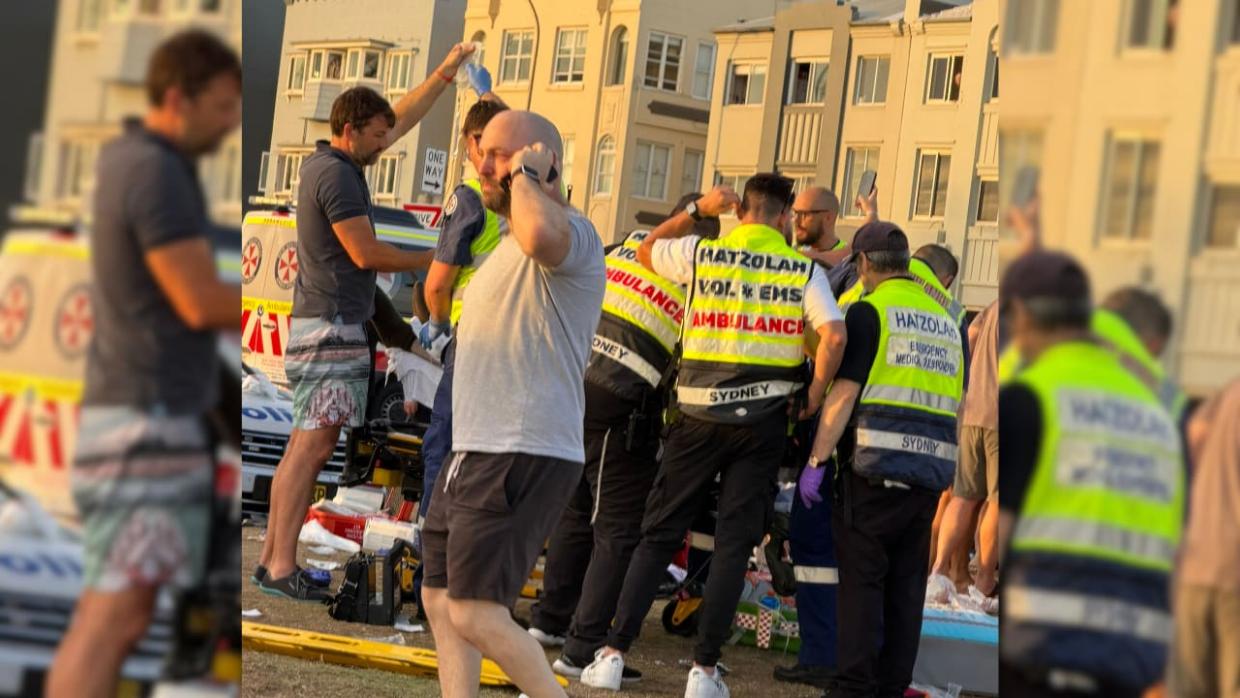
The light of Chanukah this year is dimmed and diminished even before it is lit. The news of a horrific terror attack at a Chanukah event at Bondi Beach in Australia has shaken us to the core. Ten innocent people were murdered, among them the Chabad Rabbi, Rabbi Eli Schlanger Hy”d. Australia has become a hotbed of antisemitism, met far too often with a grossly insufficient response by government and authorities. Chanukah begins with a painful reminder that when our enemies march to the chant of “globalize the intifada,” they mean it. And they must be confronted.
It is far too soon to truly process or respond to such a heinous crime. But anyone with a sensitive soul cannot avoid the question that rises unbidden in the heart. How do we light candles, gather with family, sing songs of gratitude, spin the dreidel, and eat latkes in the shadow of such devastating loss and tragedy?
Two years ago, six holy hostages held captive by the evil Hamas terrorists gathered around a makeshift menorah fashioned from paper cups to light Chanukah candles. In an act of cruelty meant to compound the suffering of the hostage families, their wicked captors recorded the moment on video. That footage was later discovered by the IDF in Gaza, shared privately with the families, and only recently released in time for Chanukah this year. The video shows each of the hostages thin, weakened, but still alive. Some even smile at the camera. Among them is Hersh Goldberg Polin, missing the lower half of his left arm, blown off by a grenade on October 7.
In the video, almost impossible to comprehend, the hostages can be heard singing the beracha of Shehechiyanu, thanking Hashem for enabling them to reach that moment. Ultimately, all six, Hersh Goldberg Polin, Eden Yerushalmi, Ori Danino, Alex Lobanov, Carmel Gat, and Almog Sarusi, were brutally murdered by their captors in a tunnel in Rafah on August 29, 2024. Their bodies were discovered by Israeli troops two days later.
Released hostages later shared that when they encountered Hersh in captivity, he strengthened them with words of encouragement. He would quote the teaching made famous by Viktor Frankl, that those who have a why to live can bear almost any how. That belief empowered Frankl to survive the Holocaust. Though Hersh was ultimately murdered, it gave him the courage to live each day in captivity, and through it, he helped others survive and return home.
On that recently released video, as Hersh and the others light the menorah, he can be heard likening their circumstance to the Holocaust, saying, “There’s that picture of the Chanukkiah with a Nazi flag above it.”
If six hostages held captive by the evil enemies of our time, tortured and starved, could nevertheless push back the darkness with the light of the menorah, then we too can find the will and the way to respond to darkness with light. If they could smile and sing Shehechiyanu in that moment, then we can not only say Shehechiyanu, but sing it and mean it, more grateful than ever to be alive and present in this moment.
The Jews of Australia, and Jews around the world, are not the first to confront the challenge of lighting Chanukah candles against a backdrop of darkness. Two years ago, six hostages found a way to light in the darkest of places. Over eighty years before them, in the depths of Bergen Belsen, Jews also found a way to light and to sing Shehechiyanu.
In her Hasidic Tales of the Holocaust, Professor Yaffa Eliach shared the extraordinary story of Chanukah in Bergen Belsen:
Chanukah came to Bergen Belsen. It was time to kindle the Chanukah lights. A jug of oil was not to be found. No candle was in sight. A menorah belonged to the distant past. Instead, a wooden clog, the shoe of one of the inmates, became a menorah. Strings pulled from a concentration camp uniform became wicks, and black camp shoe polish became oil.
Not far from heaps of bodies, living skeletons assembled to participate in the kindling of the Chanukah lights. The Rabbi of Bluzhov lit the first light and chanted the first two blessings in his pleasant voice, the melody filled with sorrow and pain. When he was about to recite the third blessing, he stopped. He turned his head and looked around as if searching for something.
Then he turned back to the quivering lights and, in a strong, reassuring, comforting voice, recited the third blessing. “Blessed are You, Hashem our God, King of the Universe, who has kept us alive, preserved us, and enabled us to reach this season.”
Among those present was Mr. Zamietchkowski, one of the leaders of the Warsaw Bund, a sincere and thoughtful man with a passion for discussing faith and truth. When the ceremony concluded, he pushed his way to the Rabbi and said, “Spira, I understand your need to light Chanukah candles in these wretched times. I can even understand the second blessing, ‘Who performed miracles for our fathers in days of old at this season.’ But the third blessing I cannot understand. How could you thank God for keeping us alive when hundreds of Jewish bodies lie in the shadows of the Chanukah lights, when thousands of living skeletons walk this camp, and millions more are being massacred? For this you are thankful? This you call keeping us alive?”
“Zamietchkowski, you are one hundred percent right,” the Rabbi answered. “When I reached the third blessing, I too hesitated. I asked myself what to do. I turned my head to ask the Rabbi of Zaner and other distinguished rabbis standing near me whether I could recite it. But as I turned, I saw behind me a large throng of living Jews. Their faces were filled with faith, devotion, and focus as they listened to the kindling of the Chanukah lights.
“I said to myself that if God has such a nation, a people who at a time like this, when they see before them the bodies of their beloved fathers, brothers, and sons, when death lurks in every corner, still stand together listening with devotion to the blessing ‘Who performed miracles for our fathers in days of old at this season,’ then I am obligated to recite the third blessing.”
That night in Bergen Belsen, Mr. Zamietchkowski saw only what lay before him, death and unbearable suffering. The Rebbe saw that as well. But he also saw another layer of truth that was just as real. He saw a people who clung to faith and refused to surrender their spiritual dignity even in the most horrific circumstances.
Sadly, we have a long history of Chanukah overlapping with tragedy and loss. But we also have a sacred tradition of finding faith despite circumstance, and of stubbornly insisting on bringing light even when surrounded by darkness.
Our hearts and thoughts are with the Jewish community and all decent people of Australia. We pray for the families of those murdered, for the complete recovery of those injured, and for the healing of all who have been traumatized. As we light candles this year, we are not ignoring the darkness. We are following in the footsteps of those who came before us, responding to it with deeper faith, stronger resolve, and an even greater commitment to spread light.