June 2, 2026|י"ז סיון ה' אלפים תשפ"ו The Pope, the President, and the Jewish View of AI
Print Article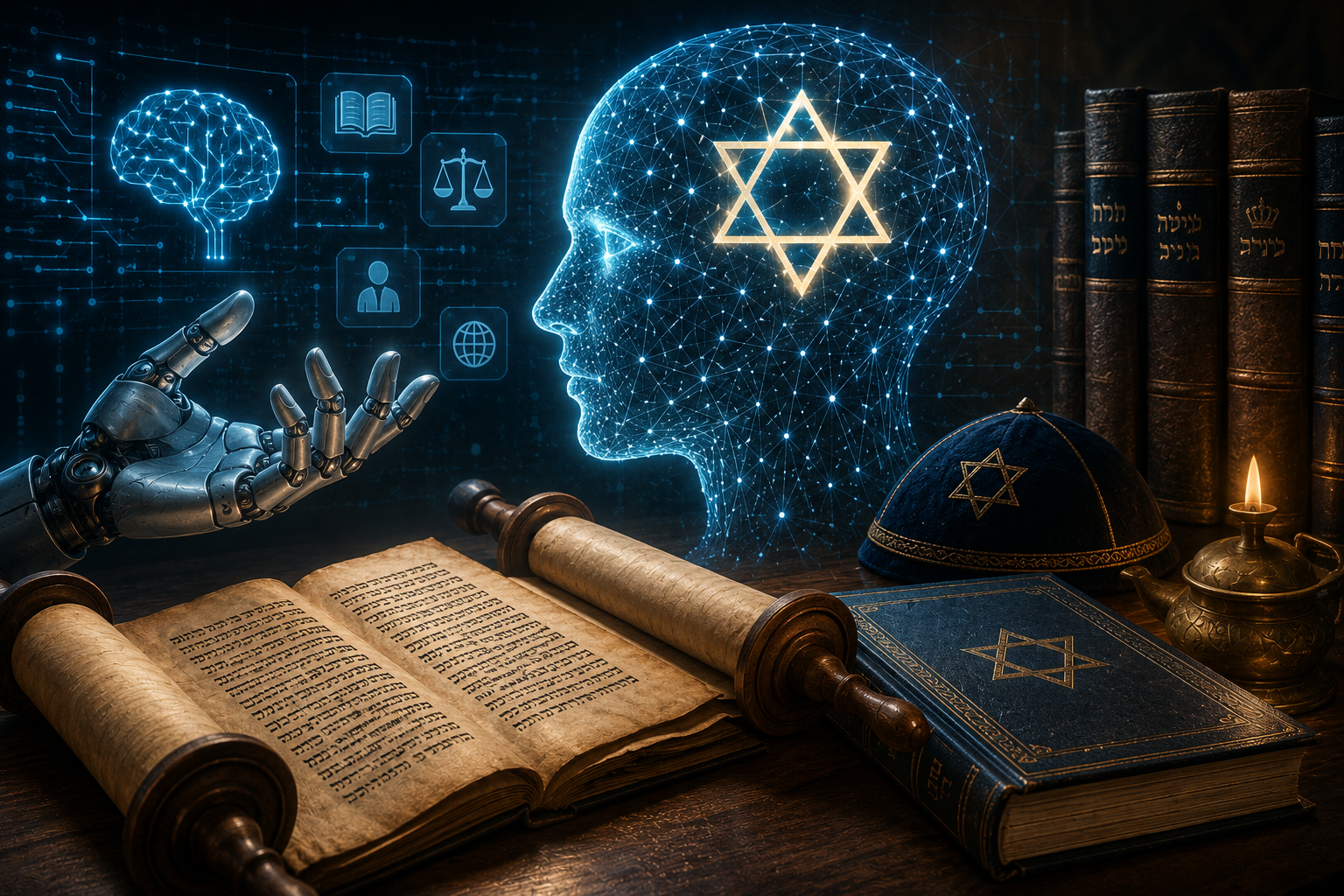
Recently, Pope Leo XIV and President Trump found themselves on opposite sides of another major issue, this time, artificial intelligence. In his new encyclical, Magnifica Humanitas, a 42,300-word letter addressed to the world's 1.4 billion Catholics on preserving human dignity in a technological age, the Pope offers a detailed vision for governing AI. He does not call for a halt to innovation, rather for a deliberate slowing of AI adoption so that ethics, law, and public oversight can keep pace with the technology's rapid advance. In effect, he argues for "disarming" AI before it acquires unchecked power over society.
President Trump has taken the opposite approach. Convinced that the United States must develop advanced AI before China does, he has championed a largely hands-off regulatory framework. In January 2025, he repealed President Biden's more cautious executive order on AI, dismissing it as an "attempt to paralyze this industry." His administration instead pledged to remove barriers to American AI leadership and accelerate innovation.
The Pope, by contrast, urges governments to establish concrete guardrails: oversight of algorithms and data management, protections against large-scale job displacement, measures to curb excessive concentrations of wealth and power, and safeguards for children in the digital world.
Both Pope Leo and President Trump would agree that artificial intelligence is taking the world by storm, leaving some awestruck and others terrified, and both reactions are understandable. There is good reason to be excited about the possibilities, but also compelling reasons to be frightened.
The debate between these two visions, innovation first or caution first, raises a broader question: What does Judaism teach about technologies that promise unprecedented benefits while carrying unprecedented risks? As AI becomes more powerful, what guidance does Jewish tradition offer for balancing innovation, human dignity, and responsibility?
We can use AI not only to be more efficient and productive and save time, but we can even use it for inspiration in strengthening our relationship with the One and only true God, Hashem. The Chafetz Chaim, R’ Yisrael Meir HaKohen (Shem Olam, Volume I), writes that while technology adds efficiency, ease, and comfort to our lives, its ultimate purpose is to serve as a metaphor that can strengthen our emunah, our faith in Hashem and in His hashgacha, His providence in the world and in our lives.
Writing a century ago, and responding to the new inventions of his time, the Chafetz Chaim explains that new technologies can help us understand and apply the Mishna (Avos 2:1): “Contemplate three things and you will not come to make mistakes: Know what is above you, a seeing eye, a listening ear, and all your deeds being inscribed in a book.”
Earlier generations were stronger in their basic emunah and did not need these illustrations to bolster their faith. However, he writes, in more recent times, when faith has weakened and doubt has increased, Hashem sends these amazing technologies, each one offering a way to better grasp aspects of emunah.
For example, the telescope enables us to understand that Hashem sees and observes everything we do here on Earth, even though He is far away. The phone enriches our belief in prayer: just as we can speak on a phone across the world and be heard instantly, so too Hashem hears all our prayers despite any distance. The Chafetz Chaim explains that the photograph, which captures an image of a person who may not even be aware they are being watched, reminds us that our lives are recorded and will one day be reviewed before our Creator. The phonograph, which records a person’s voice and plays it back later, serves as a metaphor for accountability for how we use our speech, whether for gossip, criticism, or slander.
If the Chafetz Chaim were alive today, we could imagine him adding AI to this list of tools that can strengthen our relationship with Hashem. Some people struggle to believe in or relate to a Power who is invisible, beyond physical perception, and yet who knows and sustains billions of human beings simultaneously. How can such a Being know each individual, care for them, hear them, and guide them?
Enter AI, an extraordinary human-made system that can process and respond to billions of inquiries at once. AI does not merely give generic answers; its responses can feel personalized and directed, helping individuals navigate their specific questions and needs. If an app or website can simultaneously respond to millions or billions of users, then all the more so can the Almighty know each person completely, where they come from, where they are going, and how best to guide them. If a digital system can instantly provide answers, l’havdil, Hashem listens and responds to every prayer and request.
The Ramban, in his introduction to Iyov, writes: “We must believe that God knows all individual creatures and the details of their lives.” Similarly, the Sefer HaChinuch (Mitzvah #168), in discussing the Metzora, writes that the purpose of the mitzvah is to firmly establish in our hearts that Hashem’s providence is individual and extends to each and every human being.
Though each of us is only one among more than eight billion people on Earth, our choices matter, and we matter. We should never doubt that the Master of the Universe knows where we are, where we have come from, and where we are meant to go. He listens, He responds, and He guides.
We can benefit from rapidly developing technology in a myriad of ways, and Judaism absolutely embraces and values such advancements. Of course, there are also enormous reasons for concern. One concern is that while AI can deepen appreciation for Hashem, some have warned that it may also lead people to begin metaphorically, or even literally, worshipping AI. Tech experts have raised the possibility of a “ChatGPT god,” a new form of religious-like devotion emerging around artificial intelligence.
Consider this: AI demonstrates a level of intelligence that exceeds any individual human capability. Its knowledge and processing speed appear vast and limitless. It can search all of cyberspace instantly, generate analysis, compose music, write poetry, create art, and more. It does not sleep, does not feel hunger, is not distracted by temptation, and does not experience physical pain.
Notable historian and scholar Yuval Noah Harari has suggested that AI chatbots like ChatGPT may eventually be capable of producing their own scriptures and even founding new sects or cults that could evolve into religion. He, like many early investors in AI and like the Pope, has called for stricter regulation of AI.
Another concern is that Judaism, while recognizing the benefits of tools that expand human capability, is also deeply sensitive to how such tools can distort the moral fabric of society if left unchecked. AI represents an unprecedented acceleration in the production and distribution of sheker, falsehood, at scale. Never before has there been a technology capable of so easily generating convincing text, images, audio, and video that blur the line between truth and fabrication. In an unregulated environment, this could lead to a world where people can no longer distinguish truth from illusion, undermining trust in relationships and institutions.
Just imagine a world in which people cannot tell whether what they are reading, watching, or listening to is authentic or artificially generated. What happens when couples exchange anniversary cards written by AI instead of from the heart? What happens when all communication carries the suspicion that it may not truly come from the sender?
Another consideration is that Judaism is wary of technologies that imitate human intelligence while lacking a Neshama, moral agency, and responsibility. AI can simulate thinking and productivity, but it does not love, it does not care, and it bears no obligation to human beings. For that reason, its role must remain instrumental and transactional. It can assist human effort, but it must never replace the uniquely human domains of wisdom, relationship, creativity, and moral choice.
A Stanford Medicine article from 2025 highlights serious concerns about AI chatbots, especially those designed as companions. It explains that they can sometimes produce unsafe or inappropriate responses, including content related to self-harm, drugs, or inappropriate material, even when interacting with children or teens. One of the key concerns is that younger users are especially vulnerable because they are still developing emotionally and may trust or rely on these systems as if they were real friends, which can lead to isolation and unhealthy attachments.
However, the article also emphasizes that this is not only a teenage issue. Adults can also develop emotional dependence on AI or begin to confuse the helpful responses it provides with a real relationship. Because chatbots are consistently responsive and “understanding,” it can feel as though there is a real person on the other side who cares and is forming a meaningful connection, even though there is not. The article warns that this blurs the line between information, support, and genuine human relationship, making dependency more likely across all age groups.
While AI can draw from vast amounts of information, it is still often inaccurate, inconsistent, or subtly wrong. It does not truly “know” anything; it generates responses based on patterns in data, which means it can mix sources, miss context, or present confident but unreliable answers. When it comes to Torah and Halacha, this is especially serious, because there is no room for error or guesswork in matters of practical guidance. From this perspective, AI cannot be depended upon for psak or even for serious learning in a way that replaces real guidance, because it does not understand who it is speaking to. It does not know a person’s background, level, struggles, or circumstances, and therefore cannot tailor responses the way a real rebbe or rav can and does.
That is why the transmission of Torah is described as requiring a rebbe–talmid relationship: real people with real personalities, experience, and depth connecting with one another. Learning involves more than consuming information, it is about guidance, nuance, correction, and a living relationship in which questions are understood in context and answers are given with responsibility toward the person receiving them. AI, by design, cannot replicate that kind of human connection or accountability.
The Jewish approach to AI is not one of outright rejection but of careful embrace. Judaism recognizes that technology can be a powerful tool for improving human life and even strengthening emunah and does not reflexively fear innovation. But at the same time, Torah demands boundaries, discernment, and responsibility. AI can be welcomed for its benefits, efficiency, creativity, access to knowledge, and inspiration, but it must be surrounded by clear guardrails that preserve truth, human dignity, and authentic relationships.
Ultimately, Judaism teaches that technology must remain a servant of humanity, not its replacement, nor our master, and that every advancement must be guided by the enduring values of Torah, wisdom, and moral accountability.