November 9, 2026|כ"ט חשון ה' אלפים תשפ"ז The Most Valuable Things in Life Are Often Invisible
Print Article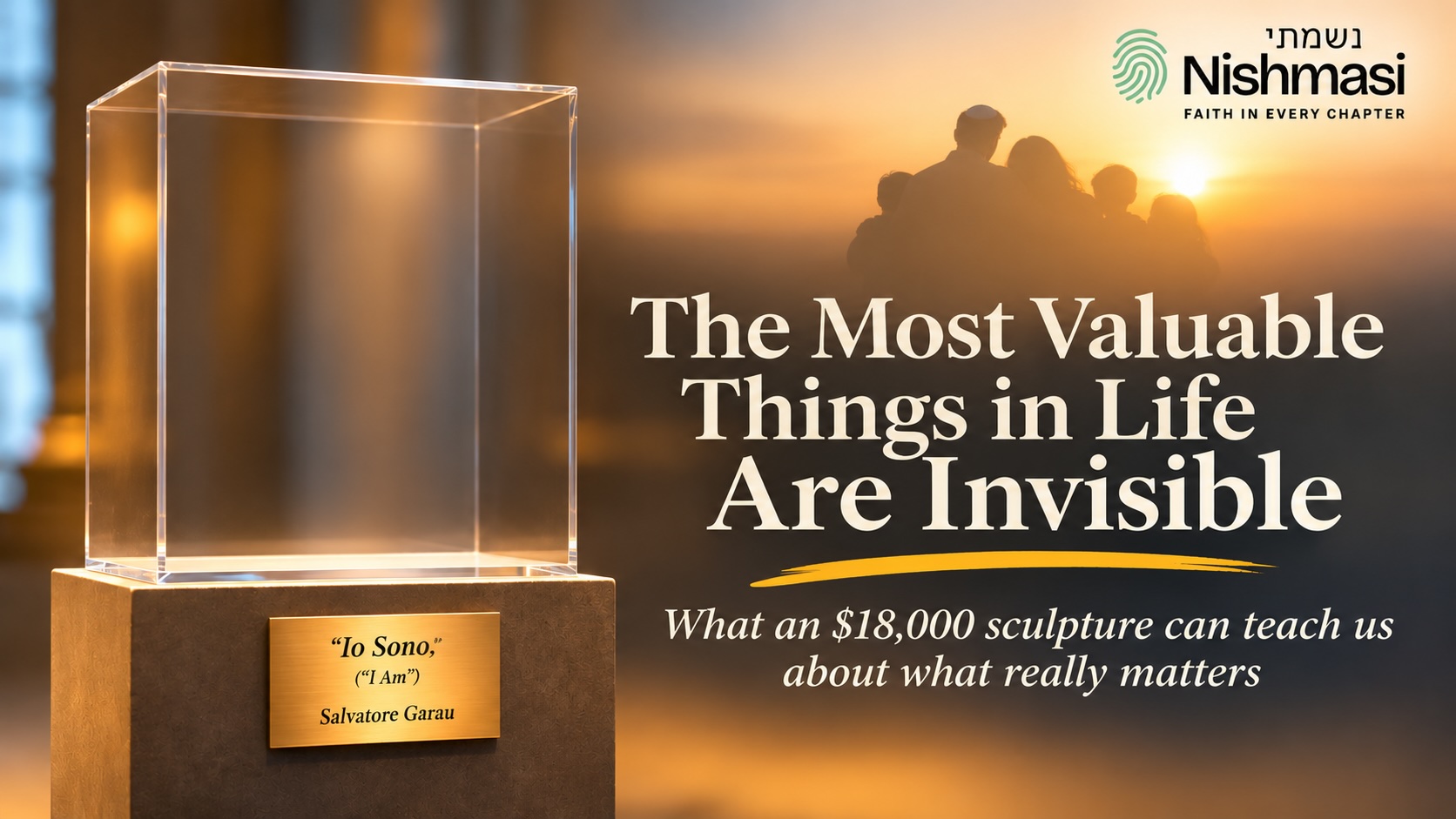
In May 2021, Italian artist Salvatore Garau made headlines around the world when one of his sculptures sold at auction for approximately $18,000. That might not sound particularly remarkable. After all, artwork routinely sells for hundreds of thousands, sometimes millions of dollars. But there was something unusual about this particular sculpture. It was invisible. Completely invisible. There was no marble, no bronze, no wood, no canvas, and no physical object of any kind. The sculpture, titled Io Sono, meaning "I Am," existed only as a concept. The winning bidder received a certificate of authenticity and instructions to display the artwork in an empty space.
Garau defended his creation by explaining that even a vacuum isn't truly empty, that seemingly empty space contains energy and potential. He argued that the sculpture was a legitimate work of art, even if it couldn't be seen or touched. Apparently, at least one person agreed enough to spend 18,000 visible dollars to own it.
When I first heard this story, I reacted with amusement. Eighteen thousand dollars for absolutely nothing? Not even a frame to hang on the wall? I am certainly no art expert, and perhaps I am missing something profound about conceptual art, but to me it sounds exceedingly ridiculous. If someone offered to sell me an invisible sculpture, I would politely decline, save the money, and enjoy the empty space for free.
But while we can laugh at the idea of paying $18,000 for something we cannot see, we should be careful not to draw the wrong conclusion. Just because something is invisible doesn't mean it isn't real, powerful, or extraordinarily valuable. In fact, history offers a remarkable example of what can happen when people fail to appreciate the significance of something they cannot see.
In the 1840s, a young Hungarian physician named Ignaz Semmelweis was working at Vienna General Hospital when he noticed something deeply troubling. Women giving birth in the maternity ward staffed by doctors were dying at dramatically higher rates than women delivering in the ward staffed by midwives. He was determined to understand why. Eventually, he made a remarkable connection. Doctors were performing autopsies and then examining women in labor, often without properly washing their hands. Semmelweis suspected they were carrying something from the deceased patients to the mothers, something invisible that was causing deadly infections. Germ theory had not yet been established, and he couldn't see or identify precisely what was responsible.
He introduced a requirement that doctors wash their hands with a chlorinated solution before examining patients, and the results were extraordinary. Maternal mortality rates plummeted. Yet rather than embrace his findings, many in the medical establishment resisted them. Semmelweis died in 1865 without seeing his discovery widely accepted. Only later, through the work of Louis Pasteur and others, would the scientific world come to understand the invisible microorganisms responsible for so much illness and death.
Think about that. Something invisible was taking lives. The fact that doctors couldn't see it didn't make it any less real, and their inability to recognize it didn't diminish its power. Semmelweis didn't need to see the source of the infections to recognize its effects and understand that it mattered. The tragedy was that so many others dismissed what they couldn't see, even when the evidence of its impact was right in front of them.
Of course, not everything invisible is necessarily real or valuable. The fact that we cannot see something doesn't automatically make it meaningful or profound. That is precisely why the invisible sculpture seems so absurd. But the opposite is equally true. Visibility doesn't establish value, and it certainly doesn't negate it. We shouldn't confuse what our eyes can perceive with what truly exists or matters.
And while Semmelweis's discovery concerned something invisible that was taking lives, some of the most important invisible things are precisely what make life worth living.
What is love worth? Can you put a price tag on the love of a spouse, the affection of a child, or the devotion of a parent? What is the market value of genuine friendship, of knowing there is someone who will be there for you no matter what? Can loyalty be weighed on a scale? Can trust be photographed? Can you deposit hope in the bank, measure peace of mind in square footage, or calculate the value of meaning and purpose?
We cannot see these things themselves, hold them in our hands, or assign them a precise numerical value, but we know how profoundly they affect our lives. We experience their impact, recognize their expressions, and feel their absence when they are missing. A person can live in an enormous mansion, drive an expensive car, enjoy every tangible luxury imaginable, and yet feel terribly empty because they lack love, connection, purpose, or peace of mind. Conversely, someone can have very little materially and nevertheless live a life filled with joy, fulfillment, gratitude, and meaning. The difference isn't necessarily what they have that can be counted, but rather what they possess that cannot.
And yet, how much of our time, energy, and attention do we dedicate to the things we can measure while neglecting the things that matter most? We measure our financial success by our net worth, our professional success by our titles, our social success by our followers, and sometimes even our personal success by the size of our homes or the vacations we take. There is nothing inherently wrong with material success, and there is certainly nothing wrong with enjoying the blessings Hashem gives us. But when we confuse what can be counted with what truly counts, we risk spending our lives accumulating things of limited value while overlooking what is genuinely priceless.
Chazal teach us in Pirkei Avos (4:1), אֵיזֶהוּ עָשִׁיר? הַשָּׂמֵחַ בְּחֶלְקוֹ — "Who is wealthy? One who is happy with his portion." Notice that the Mishnah doesn't define wealth by how much a person owns, but by how a person relates to what he has. Two people can have identical bank accounts and entirely different levels of wealth. One feels deprived, jealous, and perpetually dissatisfied, while the other feels grateful, content, and blessed. The numbers are the same, but their lives are profoundly different. True wealth isn't merely a financial condition; it is also a spiritual and emotional one, something no accountant can calculate and no bank statement can capture.
True wealth isn't only about what is visible in your bank account, but about what is invisible and lives inside your heart.
Among the most precious things in life that cannot be seen or measured is emunah, our faith and trust in Hashem. We live in a world that places enormous emphasis on what can be observed, demonstrated, and proven. We want evidence, certainty, and tangible results. We want to see that our tefillos are being answered, that our efforts are paying off, that the challenges we face have a purpose, and that the future will unfold as we hope. When we cannot see these things, when we don't understand why something is happening or where it is leading, we can begin to feel anxious, frustrated, or abandoned.
But just because we cannot see Hashem doesn't mean He isn't present, and just because we cannot understand what He is doing doesn't mean He isn't doing anything.
In Parshas Vayeitzei, Yaakov Avinu is fleeing his home and facing an uncertain future, when he has his famous dream of the ladder reaching from earth to heaven. Hashem appears to him and promises, וְהִנֵּה אָנֹכִי עִמָּךְ וּשְׁמַרְתִּיךָ בְּכֹל אֲשֶׁר תֵּלֵךְ — "Behold, I am with you, and I will protect you wherever you go" (Bereishis 28:15). When Yaakov awakens, he makes an extraordinary declaration: אָכֵן יֵשׁ ה׳ בַּמָּקוֹם הַזֶּה וְאָנֹכִי לֹא יָדָעְתִּי — "Indeed, Hashem is present in this place, and I did not know."
Think about what Yaakov is saying. Hashem hadn't suddenly arrived when Yaakov had his dream. He had been there all along. What changed wasn't Hashem's presence, but Yaakov's awareness of it. The place that had seemed ordinary, perhaps even frightening and lonely, was revealed to be filled with holiness and Divine presence. Yaakov hadn't needed Hashem to become present; he needed to recognize the presence that was already there.
How often is that true in our own lives? We go through our days worried about our families, our health, our finances, our relationships, and our futures. We confront disappointments and frustrations, sometimes large and sometimes small, and we become so consumed by what is happening around us that we lose sight of Who is with us through it all. We may not have the privilege of a prophetic dream like Yaakov Avinu, but we can work on developing the awareness that allowed him to declare, "Hashem is in this place, and I didn't realize it."
Of course, emunah doesn't mean pretending that everything is easy, denying that suffering is real, or claiming to understand why painful things happen. It doesn't mean that if we believe strongly enough, every illness will disappear, every relationship will be repaired, or every financial challenge will resolve exactly as we want. We don't always understand Hashem's ways, and we should be careful not to presume that we do. Emunah means that even when we don't understand, we can work to trust. Even when we don't see the path forward, we can remember that we are not walking alone.
There is, however, an important distinction between recognizing that something invisible is valuable and actually allowing it to shape the way we live. We cannot see love itself, but we can see the kindness, patience, generosity, and sacrifice it inspires. We cannot see loyalty, but we appreciate it when someone shows up for us when it isn't convenient. We cannot see gratitude, but we recognize it in someone who appreciates what they have rather than constantly focusing on what they lack. And while we cannot see emunah itself, we can recognize its influence in the way a person responds to uncertainty, disappointment, success, and the ordinary frustrations of everyday life.
This is the idea behind our new project, Nishmasi, and our effort to help people not merely learn about emunah, but practice it and live it every day. Emunah shouldn't remain an invisible idea we profess to believe in; it should become a visible influence on how we live.
Perhaps that is what makes the story of Semmelweis so compelling. Once he recognized the significance of what he couldn't see, he changed the way he practiced medicine, and lives were saved. Recognizing the invisible was only the beginning. What mattered was what he did with that recognition.
The same is true for us. If we recognize that love is priceless, we need to invest more in our relationships. If we recognize that gratitude is a greater source of happiness than accumulating possessions, we need to spend more time appreciating what we have. And if we truly believe that Hashem is present in our lives, even when we cannot see or understand His ways, that awareness should and hopefully will influence how we confront challenges, celebrate blessings, and approach each day.
I still wouldn't pay $18,000 for an invisible sculpture. But I also wouldn't want to make the far more consequential mistake of spending my life pursuing only what I can see, count, and measure, while overlooking what is genuinely priceless.
The most valuable things in life aren't always the things we can see. They are the things we cannot afford to live without.